Turn GitHub stars into an actual developer workspace.
StarDash syncs your starred repositories, adds tags, collections, notes, AI repo analysis, contribution triage, and intent-first discovery so saved projects become useful again.
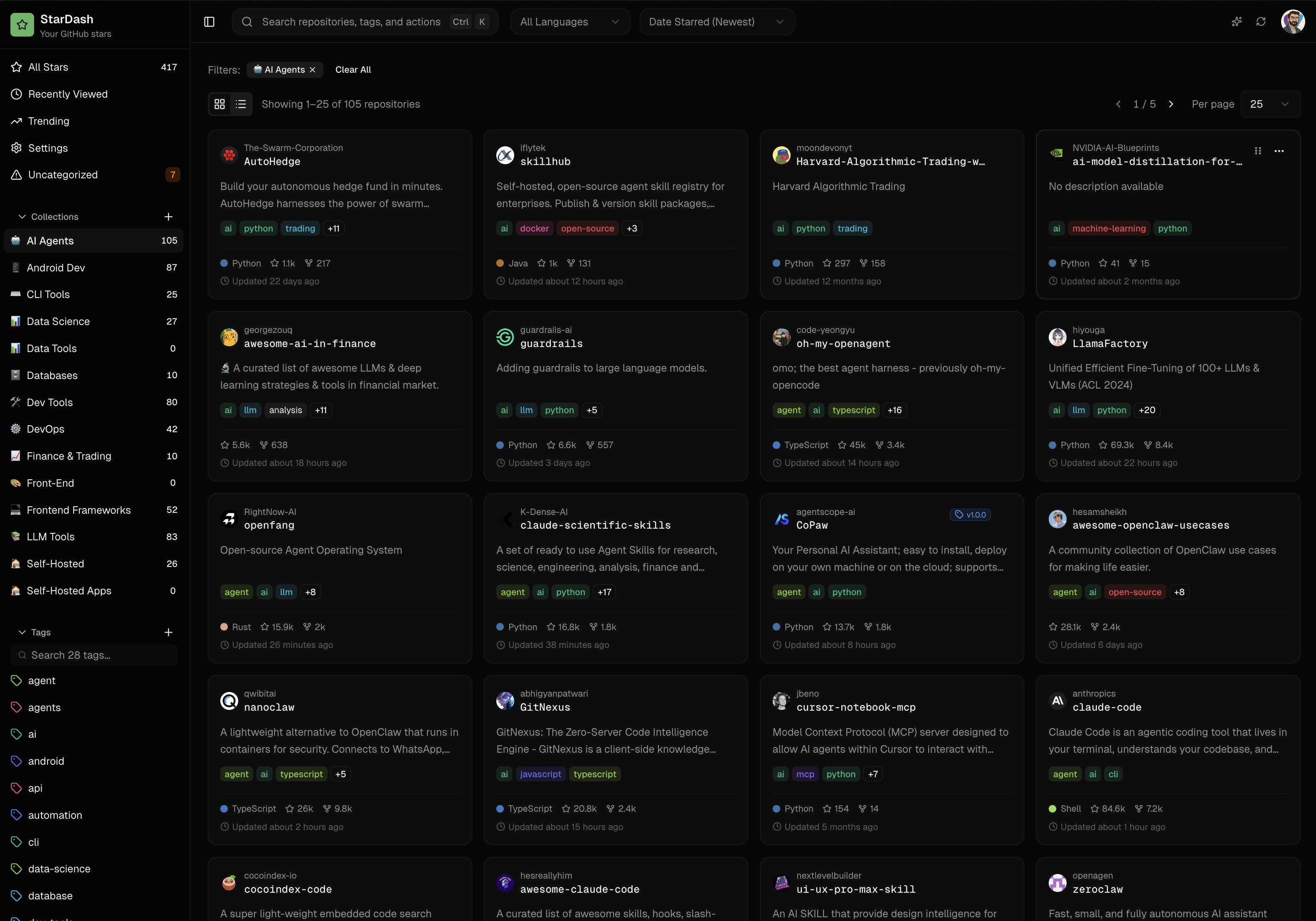
Starring a repo is easy. Recovering the reason later is the hard part.
StarDash is built for developers who use stars as research, backlog, evaluation queue, and long-term reference, then need more than GitHub's native starred page.
Stars are a weak memory system
GitHub remembers that you clicked a star. It does not remember why, where it fits, whether you tried it, or what you wanted to compare it against.
Search breaks when intent is fuzzy
The repo name is rarely the thing you remember. You remember the use case: async runtime, auth library, promising CLI, abandoned dependency.
Evaluation context gets scattered
READMEs, issue health, notes, contribution candidates, and trend signals live in separate tabs. StarDash pulls them into one operating surface.
A homepage that shows the app, not a vague promise.
The public page now mirrors the real product: curation dashboard, Discover search, repo intelligence, and contribution triage.
Command framework for Node.js CLIs
Simple, fast package for Go CLIs
Turn favorite repos into open-source work you can actually start.
The Contribute page scans active starred repos with open issues, ranks opportunities by fit and quality, then gives you filters and an AI brief so you can decide what is worth opening.
Filter the work
Language, difficulty, contribution type, and text search over repo or issue title.
Ranked issue feed
Scores blend labels, body context, recency, comments, pinned repos, risks, and repo activity.
AI contribution brief
Summary, why it fits, first steps, likely files, questions to ask, and a prompt.
Assistant-ready handoff
Copy the generated coding assistant prompt and paste it into Codex, Claude Code, or another tool.
Clarify when route cache invalidation runs and add a short example for nested layouts.
- Read the issue and linked discussion.
- Find docs covering cache invalidation.
- Add the smallest example that answers the report.
You are helping resolve GitHub issue #4821 in vercel/next.js.

Goal: improve docs for route cache invalidation.
Start by inspecting the docs routing cache section, then propose the smallest docs patch with a runnable example.
Search by intent, product need, stack constraint, or fuzzy description. The backend expands it into GitHub syntax before ranking.
Choose authenticated or public GitHub search mode.
Generate 3-5 targeted GitHub search queries.
Fetch public repository candidates in parallel.
Remove duplicates across expanded searches.
Score every candidate and attach evidence notes.
Sort and trim the final ranked grid.
CRDT framework for shared data types
SDK for infinite canvas whiteboards
Describe the repo you need. StarDash searches like a researcher, not a keyword box.
Discover accepts natural language intent, expands it into targeted GitHub queries, retrieves candidates, dedupes them, reranks every repo with AI, and returns up to 24 evidence-backed results.
3-5 query expansions
The model generates GitHub search syntax with operators like stars, language, topic, and public visibility.
Parallel candidate retrieval
Each expanded query hits GitHub repository search, then duplicate full names are merged.
0-10 relevance score
AI reranking attaches a score and exactly three short evidence notes for each repository.
Saved and cached searches
Fresh cached results can be reused, saved searches are preserved, and cache hits do not spend AI quota.
The UI consumes an NDJSON stream, so users see each backend stage complete instead of waiting on a blank loading state.
Everything is centered on one job: make saved repos usable.
StarDash covers the full loop from sync and organization to evaluation, rediscovery, and contribution planning.
Curation dashboard
Sync up to 5,000 starred repositories, then filter by language, status, tag, collection, archived state, or uncategorized state.
Search your own memory
Search repo names, owners, descriptions, private notes, and tags without rebuilding context from GitHub every time.
AI taxonomy pass
Generate 5-12 collections and a shared tag vocabulary from your starred repos, then review and edit the result.
Repo Intel
Run AI-assisted repo analysis with health score, maintenance verdict, adoption readiness, pain points, and practical recommendations.
Contribution finder
Scan open issues across starred repos, rank them by fit and quality, then generate a concise brief before you start.
Discover search
Describe what you are building and StarDash runs an AI-guided GitHub repository search with saved searches and personalized themes.
Trending signals
Analyze your most recent starred repos to surface popular, active, and hidden-gem repositories already related to your interests.
Recently viewed
Jump back into repos you opened from dashboard, trending, or detail views without retracing your filters.
Tags, collections, statuses, notes, and pins explain why a repo matters.
The dashboard stores user-owned metadata separately from the global repo catalog, so your labels, notes, and workflow state remain personal.
Tag vocabulary
Create, edit, color, and delete tags from Settings or while assigning repos.
Collections
Group related repositories and track repo counts across your personal taxonomy.
Private notes
Attach freeform notes and save them directly from the repo detail drawer.
Pinned repos
Keep the repos you actually use above the long tail.
A practical loop for repo research.
No CSV import flow and no separate knowledge base to maintain. The app starts from your GitHub stars and keeps the workflow close to the repos.
Connect GitHub
Supabase OAuth stores the provider token server-side so StarDash can sync your starred repositories and refresh metadata.
Make the backlog navigable
Use search, sorting, pinned repos, status labels, tags, and collections to turn passive stars into an active reference library.
Add judgment
Attach notes, read READMEs inline, inspect repo health, and generate contribution briefs when a repo deserves a closer look.
Keep resurfacing value
Use recently viewed history, Discover searches, and trend buckets to find the right tool when the original star is long forgotten.
The AI features do first-pass organization and evaluation, then get out of your way.
StarDash uses model calls for taxonomy generation, personalized Discover themes, repo intel, and contribution briefs. The outputs are editable, cached where useful, and tied back to concrete repo data.
Session checks on every request
Supabase middleware refreshes the session and protected routes validate users with `supabase.auth.getUser()` before loading app data.
GitHub tokens stay server-side
OAuth access uses an `httpOnly`, `sameSite=lax` cookie. If that cookie expires or is missing, route handlers repair it from a server-only token table.
Your metadata is scoped to you
Tags, collections, notes, statuses, saved Discover searches, and repo assignments use RLS policies keyed to `auth.uid()`.
Bring your own AI key
Optional AI provider keys are saved in your browser localStorage, sent as request headers only for AI calls, and can be cleared from Settings.
System-key AI calls are rate-limited, cron and observability test routes require `CRON_SECRET`, and cached Discover searches are capped per user.
Sentry records runtime errors and Langfuse receives AI SDK telemetry only when configured, with traces flushed from long-running AI routes.
Built around private developer context, not public leaderboards.
StarDash stores personal repo context behind your authenticated account, keeps GitHub access out of client code, and makes AI usage explicit.
Repo metadata, notes, tags, and search/AI outputs are used to power your workspace. AI features send the relevant prompt context to the configured model provider; using your own key routes those calls through the provider you choose.
Stop treating GitHub stars like a junk drawer.
Connect GitHub once. Sync the backlog, organize it, inspect the repos that matter, and return to the right project when you need it.
Your stars, notes, tags, and collections stay tied to your account.